





























Key Insights

Everyone Is Building Trains. Few Are Building the Tracks
I’ve always been obsessed with history. I’m pretty sure it stemmed from growing up around my uncle, who would be planted on the couch watching hours of History Channel content every day. For as long as I can remember, there’s always been an obsession with the past.
After 10 years in the world of ad-tech, like most middle-aged men, I’ve transitioned to agentic AI. With that change, I’ve been racking my brain for the most apt historical analogy for this turning of the world.
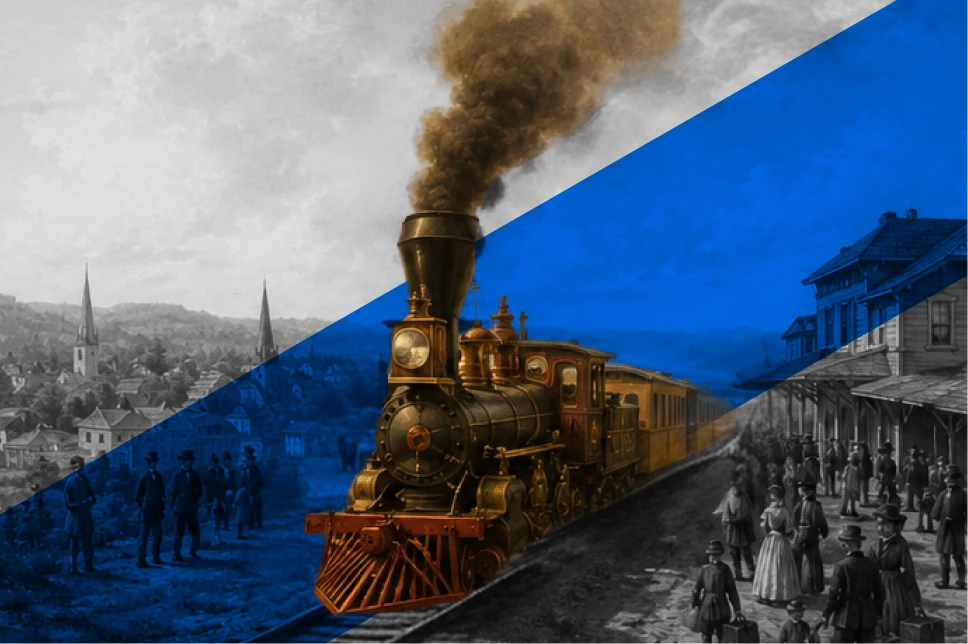
Some people are comparing it to the dot-com boom/bubble. Others see it more as a California gold rush-style movement. The time in history that I keep coming back to though, is the railroad expansion of the 1800s in America.
During the railroad boom of the 1800s, thousands of miles of track were laid across America. Investors poured money into new rail companies. Competition was fierce. Every company promised faster routes, better service, and revolutionary growth.
Sound familiar?
The biggest challenges for adoption & expansion of the railroad system weren’t the trains themselves. They were the systems underneath them. And while this analogy might seem outdated, railroads still account for 28-40% of U.S. freight movement.
Today, AI is experiencing a similar track 😉. There are hundreds of AI startups, massive investment/valuations, new agent use cases every week, and a race to capture the most market share before the industry consolidates.

The Land Grab
Every company in the space is fighting for the same finite resource: business adoption. Once a company implements an AI receptionist or operational agent, if the underlying tech delivers on its promise of efficient business optimization, that business stops evaluating other competitors in the space.
This urgency is already creating some friction. I’m seeing a lot of companies built by overpromising & underdelivering. Spinning up vibe-coded, single-use tools. Not thinking critically about long-term infrastructure, the necessary safety & compliance, and how this world evolves in five, ten, and fifteen years.
Most companies are building the visible layer, the train. The demos, the chat-bots, the voice agents, the automation. But what happens when a legacy LLM goes down, call volume spikes, a business needs to handle 10,000 simultaneous interactions, or regulations change across industries? Many vendors that just provide an API pipe don’t have the answers. And there’s a reason: Building an AI demo is easy. Building AI infrastructure is hard.
The Forgotten Lessons of Railroads
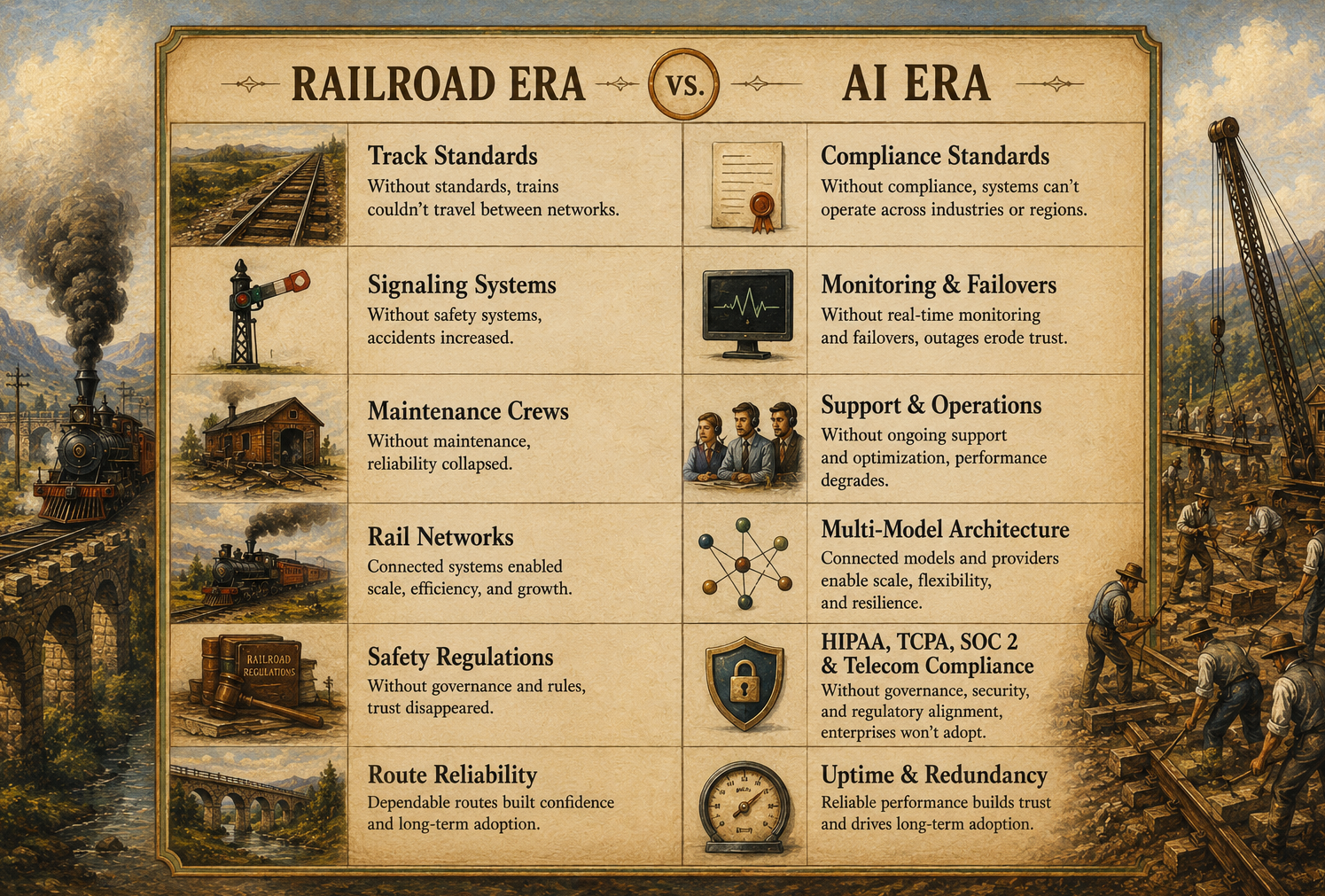
Railroads across America became transformative because of standardized track width, signaling systems, maintenance infrastructure, and regulatory frameworks. Not the trains themselves. Over the next couple years we’ll see the same thing happen in AI.
Track Standards → Compliance Standards: Railroads couldn’t connect the country until everyone agreed on standards. AI won’t connect enterprise workflows until compliance and governance become foundational.
Signaling Systems → Monitoring & Failovers: Railroads invested heavily in safety systems to prevent catastrophic failures. AI requires the same level of resiliency through monitoring, redundancy, and automatic failovers.
Maintenance Crews → Support & Operations: Trains didn’t keep running because they were built well; they kept running because they were maintained. AI success depends just as much on operational support as it does on the technology itself.
Rail Networks → Multi-Model Architecture: Connected rail networks unlocked scale and flexibility. Multi-model AI architectures create the same resilience by avoiding dependence on a single provider.
Safety Regulations → Trust & Governance: Trust made railroads essential infrastructure. Trust, security, and compliance will determine which AI platforms become enterprise infrastructure.
Route Reliability → Uptime & Redundancy: Businesses relied on trains arriving when expected. Enterprises will ultimately choose AI platforms based on reliability, not hype.
What Enterprise Buyers Are Starting To Realize
The way I see it, the first wave of AI buying has been focused on the features, demos, and cost savings. The next wave will be all about reliability, compliance, security, and scale. So, with that in mind, if I’m a product manager, CRO, or developer evaluating potential AI partners to deploy across my business, there are a few important questions to ask.
- Can your technology access multiple LLMs and survive an outage?
- How are you remaining compliant, how do you support telecom requirements, and what is your workflow for staying ahead of the curve?
- How do you ensure we can scale to enterprise-level volumes?
These are the hard, uncomfortable questions that make salespeople nervous. And as a seasoned seller myself, if I were underprepared & not confident to answer these questions, you’d be able to tell.
The good news for me is that I can answer all of these questions because the core of our company was built with them in mind.
The Infrastructure Is Becoming The Differentiator
At first, a lot of people thought I was crazy to make this kind of career pivot. 10-years of sweat equity and networking in ad-tech. A newborn. A move across the country. A new house. There was a lot going on.
Ultimately, I’ve always believed the best decisions in life happen under extreme circumstances/pressure. And the more I spoke to mentors about Vida, the more everything started to make sense.
Vida was built by operators, not AI hobbyists or prompt engineers. Our founders and core team of 12 is filled with telecom executives, people who have built & scaled organizations from zero, and killer engineering minds that enjoy the aspects of AI that give us commonfolk migraines.
If you've stayed with me this far, you’ve had to know Vida & what we’ve built was going to be feathered in at some point, right?
- We’re SOC 2 Type II certified, HIPAA-ready with signed BAAs, SIP enabled, and automatically manage telecom compliance (STIR/SHAKEN, TCR, A2P 10DLC, TCPA). For customers in healthcare, legal, and financial services, the compliance infrastructure is already built in.
- We’re LLM agnostic. Most vendors will tell you ‘our AI runs on X model.’ The hard part is that businesses run on outcomes, not models. That means there’s complete necessity for model optimization, automatic failovers, multiple voice providers, throughput management, and efficient token allocation.
Just like railroad infrastructure, passengers didn’t care which steel supplier built the rails. They cared that the train arrived safely and on time. At Vida, we mirror that operational infrastructure to help customers deploy, optimize, and scale.

The Companies That Win Won’t Be The Loudest
All our friends, family, co-workers, and grocery store cashiers have thoughts about AI. It’s amazing. It’s scary. The real truth is that AI is maturing. And as the market matures, infrastructure matters more than hype.
The railroad boom wasn’t won by the companies with the most ambitious advertisements. It was won by the organizations that built reliable networks capable of moving people and commerce safely at scale.
AI is heading toward the same inflection point.
The companies that survive the coming consolidation won’t be determined by who built the flashiest demo or raised the most capital. They’ll be determined by who built the infrastructure businesses can trust to run mission-critical operations for years to come.
In AI, the future belongs not to the trains, but to the tracks.
Association of American Railroads - U.S. freight rail market share (28-40%): https://www.aar.org/